

Concepts
Abada runs business processes in which AI agents, deterministic rules and people work together. This page introduces every capability in a few lines, with a short APL excerpt, what the engine guarantees and where that guarantee stops. Each section links to the page that explains it fully.
Capabilities marked New in 1.1.0-rc.2 arrived
with the 1.1.0-rc.2 evaluation release candidate.
The one idea: agents advise, the engine decides
Section titled “The one idea: agents advise, the engine decides”flowchart LR
A["Agent<br/>(outside the transaction)"] -- proposes --> E{"Engine<br/>checks the contract"}
E -- valid and allowed --> R["Rules decide<br/>(CEL, decision tables)"]
E -- needs a person --> H["A person approves<br/>or rejects with a comment"]
E -- invalid, weak, too costly --> F["A declared route<br/>or an incident"]
R --> P[("PostgreSQL commits<br/>state, history, outbox")]
H --> P
F --> P
A model never changes process state by itself. Its answer enters the process only through an engine command that validates it, inside one PostgreSQL transaction with the history and the events that describe it.
Processes
Section titled “Processes”Processes are APL documents
Section titled “Processes are APL documents”A process is a YAML document in APL (abada.io/v1). Studio draws it as a
diagram and edits both views as one document; the engine compiles it directly.
version: abada.io/v1metadata: { key: refund_agent, name: Refund agent }flow: entry: request-received nodes: - { id: request-received, type: webhook, next: handle } - { id: handle, type: agent, model: gemini-3.6-flash, prompt: "…", next: done } - { id: done, type: end }- Guarantee. Deployment validates the whole document and rejects anything ambiguous, at its path, before anything runs.
- Limit. APL is the authoring format; BPMN 2.0 is an import boundary with a tested subset.
Author processes in APL · Native APL and the canonical model
Versions are immutable
Section titled “Versions are immutable”Each deployment is a new version. A running instance keeps the version it started with, including the tool servers and child processes it was bound to.
- Guarantee. Redeploying never changes the behavior of running instances.
- Limit. Fixing a running instance means retrying or cancelling it, not editing its definition.
Agents advise
Section titled “Agents advise”Agents are durable work
Section titled “Agents are durable work”An agent step becomes durable external work on the abada:agent topic. A
worker (the first-party Agent Worker or your own) leases it, calls the model
and reports back through an engine command.
- Guarantee. No model is called inside a workflow transaction. A dead worker’s lease expires and another worker continues; a late report after a cancellation is rejected.
- Limit. With no worker running, agent steps wait — they do not fail.
Agent nodes and the Agent Worker · Agent Worker execution
The output contract
Section titled “The output contract”- id: classify type: agent result_variable: classification output_schema: type: object required: [category, severity] properties: { severity: { enum: [low, medium, high] } } confidence_threshold: 80 on_invalid_output: review on_low_confidence: review- Guarantee. The engine — not the worker, the model or the UI — checks the answer against the schema and the confidence threshold before it is stored. A rejected answer takes its declared route or counts as a failed attempt.
- Limit. A valid answer can still be wrong; the contract bounds its shape and confidence, and a review step is how you bound its content.
Fallback models
Section titled “Fallback models”fallback_models lists up to three models tried while the one before is
rate-limited or unavailable. Invalid or weak answers never switch the model.
Fallback models
Rules decide
Section titled “Rules decide”Deterministic rules
Section titled “Deterministic rules”- id: route type: condition rules: - if: "${classification.severity == 'high'}" then: escalate - else: draft then: draftConditions and decision tables are sandboxed CEL, evaluated inside the transaction.
- Guarantee. The same inputs give the same decision; an expression that cannot be evaluated fails loudly instead of guessing; CEL cannot reach the JVM.
- Limit. Rules see process variables only, never external systems.
Humans approve
Section titled “Humans approve”Review decisions with a comment
Section titled “Review decisions with a comment”A human-input step can declare outcomes; rejecting requires a comment the
next agent reads.
Review decisions
Service levels
Section titled “Service levels”sla_hours marks a late task escalated; on_timeout routes the process
elsewhere after a deadline.
Service levels ·
Timeouts
Process shapes
Section titled “Process shapes”Bounded loops and routes
Section titled “Bounded loops and routes”Every cycle needs a loop bound, and every way out of a step — an error, a
timeout, a weak answer — is a named route on the canvas.
Loops, routes and review decisions
Routing agents
Section titled “Routing agents”An agent may choose the next step, but only among the routes its node declares,
and a route’s when lets the engine veto the choice.
routes: refund: { next: investigate, description: The customer asks for money back, when: "request.amount <= 500.0" } escalate: { next: manual, description: Anything unclear, angry or legal }- Guarantee. An undeclared route, or one whose
whenis false, is treated as an invalid answer; the route taken is recorded with the confidence. - Limit. The model chooses by the descriptions you write; vague descriptions give vague routing.
Let the agent choose the next step
Agents that act
Section titled “Agents that act”Tools and tool servers
Section titled “Tools and tool servers”Agents use tools declared by a project tool server (an MCP server reached
over streamable HTTP). Each tool has a policy: read, write or
approval_required.
# Tool server (project resource)name: paymentstransport: streamable-httpurl: https://payments-mcp.internal/mcptools: get_order: { policy: read } refund: { policy: approval_required, idempotency: none, approvers: [finance] }# Agent nodetools: - payments/get_order - payments/refund- Guarantee. An agent can call only the tools bound to its node, frozen with the definition version. A node can tighten a policy, never loosen it. The worker additionally refuses servers its operator did not allow.
- Limit. The engine never connects to a tool server: the worker does, with the project’s tool credential.
Tools and tool servers · Tutorial: an agent that acts
A person approves a write
Section titled “A person approves a write”An approval_required call is journaled as proposed: the agent’s work
parks without a worker and an approval task opens for the approver groups,
showing the exact arguments.
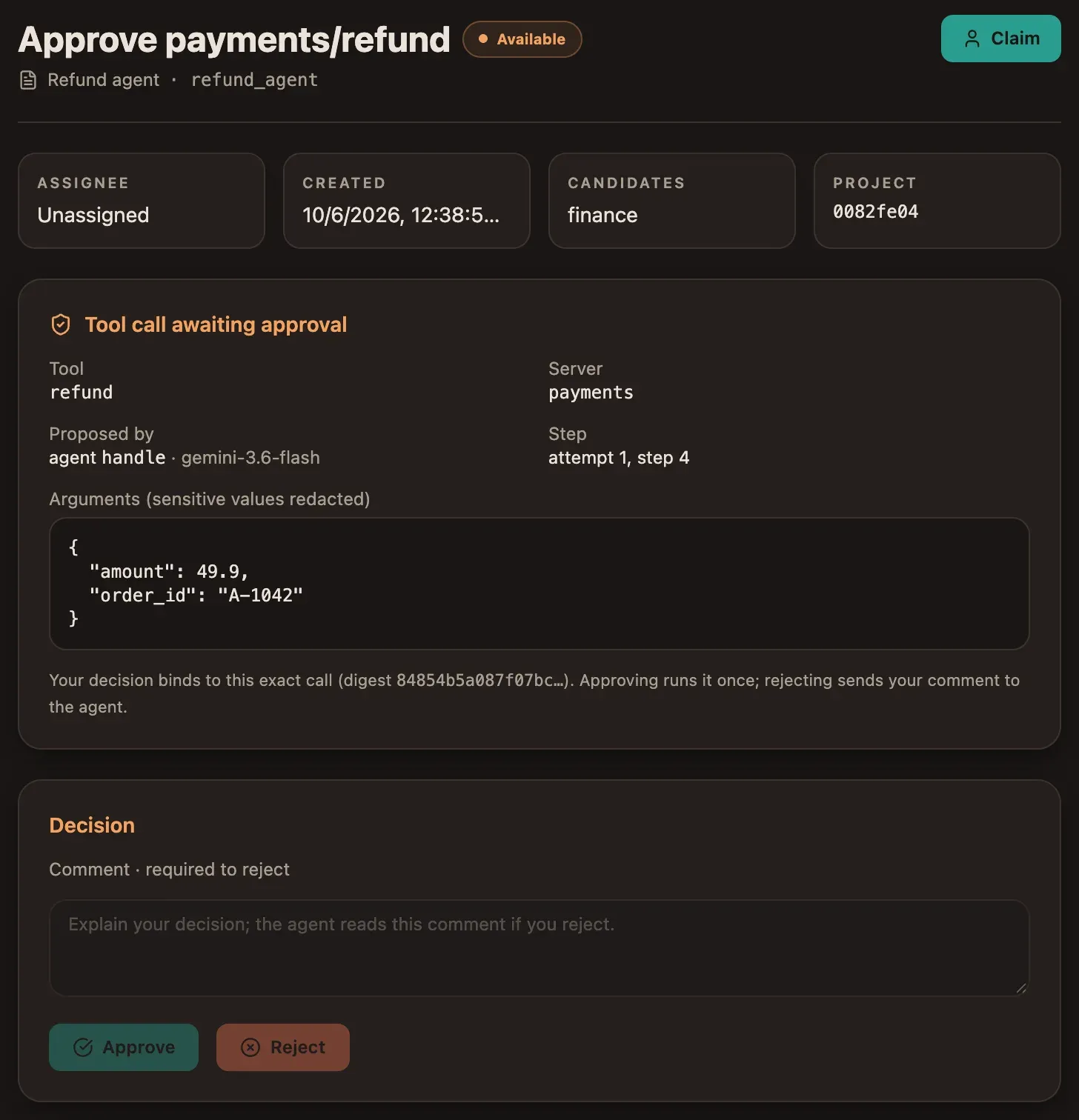
- Guarantee. The call runs only after a candidate approves it, and only with the approved arguments. A worker credential can never decide. A rejection’s comment goes back to the agent.
- Limit. The approver sees the arguments the evidence policy keeps; sensitive values may be redacted.
Approving an agent’s tool call
A crash never repeats a write blindly
Section titled “A crash never repeats a write blindly”Every model and tool call is journaled before it runs. A restarted worker continues from the journal instead of starting over.
- Guarantee. A write whose server accepts an idempotency key is re-sent
with the same key. A write without one that was interrupted is never
re-sent: the step becomes
OUTCOME_UNKNOWNand an incident asks a person whether it happened. A later attempt that asks for the same write gets the recorded result instead of sending it again. - Limit. Without an idempotency key, someone must check the target system; external effects stay at-least-once unless the server deduplicates.

Limits and cost
Section titled “Limits and cost”max_turns: 6 # model calls per attemptmax_tokens_total: 50000budget_usd: 0.05 # computed by the engine from model prices- Guarantee. The engine checks the limits before each model call is
journaled and computes cost from your model prices;
a budget fails closed for an unpriced model. Reaching a limit ends the step
with
AGENT_BUDGET_EXHAUSTED, routable throughon_error. - Limit. Cost is an engine estimate from token counts and your prices, not the provider’s invoice.
Composition
Section titled “Composition”Call another process
Section titled “Call another process”- id: payout type: call-process process: refund_payout inputs: { order_id: "${request.order_id}", amount: "${request.amount}" } outputs: { payout_id: payout_id }The child runs as its own instance, with its own locks, history and reviewers; only the mapped outputs come back.
Let an agent delegate
Section titled “Let an agent delegate”delegates: - process: fraud_check description: Assess the fraud risk of a refund outputs: [verdict]The agent decides whether to start the child; the engine checks the inputs against the child’s declared variables, the nesting depth and, when required, a person’s approval.
- Guarantee. Child versions are pinned at deployment; lineage links every child to the instance and the agent step that started it; cancelling the parent cancels its children.
- Limit. Delegation is depth-limited (
abada.call-process.max-depth, default 4) and only to processes of the same project.
Let an agent delegate to another process · Called processes
Evidence
Section titled “Evidence”The audit trail
Section titled “The audit trail”Every command records its actor, time and identifiers in the instance history, in the same transaction as the change. Agent decisions record the model, attempt, confidence and route — never prompts, secrets or comment text.
Step evidence and payloads
Section titled “Step evidence and payloads”Each journaled step keeps digests, tokens, cost and timings. Payloads (prompts,
replies, tool arguments and results) are kept as the project’s evidence
policy allows — none, redacted (default) or full, for a retention
period — encrypted at rest.
- Guarantee. Only members with the
abada-evidence-readerrole can read payloads, and every read is recorded. - Limit. Digests prove what was sent; after retention, payloads are gone.
Operations
Section titled “Operations”Live instances and the step inspector
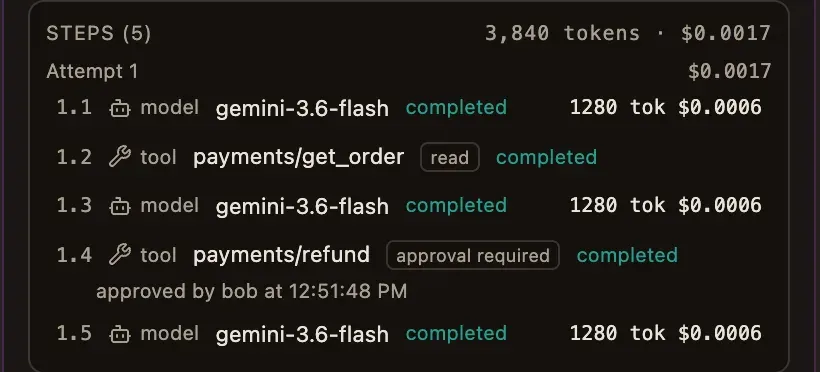
Section titled “Live instances and the step inspector”The instance page follows the project’s event stream and refreshes as soon as something happens. Its step inspector lists every model call, tool call and delegation with its policy, state, approver, tokens and cost.
Incidents and retries
Section titled “Incidents and retries”A path that cannot continue stops with an incident; the rest of the instance keeps running. An operator retries it — on another model if needed — or, for an unknown write outcome, says what happened. Incidents
Improvement
Section titled “Improvement”Insight proposes, people decide
Section titled “Insight proposes, people decide”The Insight Engine turns terminal facts into proposed APL changes. A proposal becomes a new version only after policy-compliant human review. Insight: governed AI optimization